
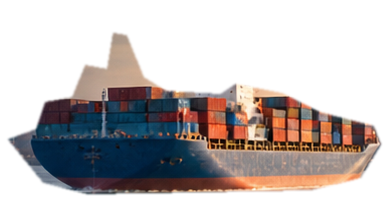

Delivery recorded, POD missing
The shipment shows delivery activity, but the required proof-of-delivery document cannot be verified.
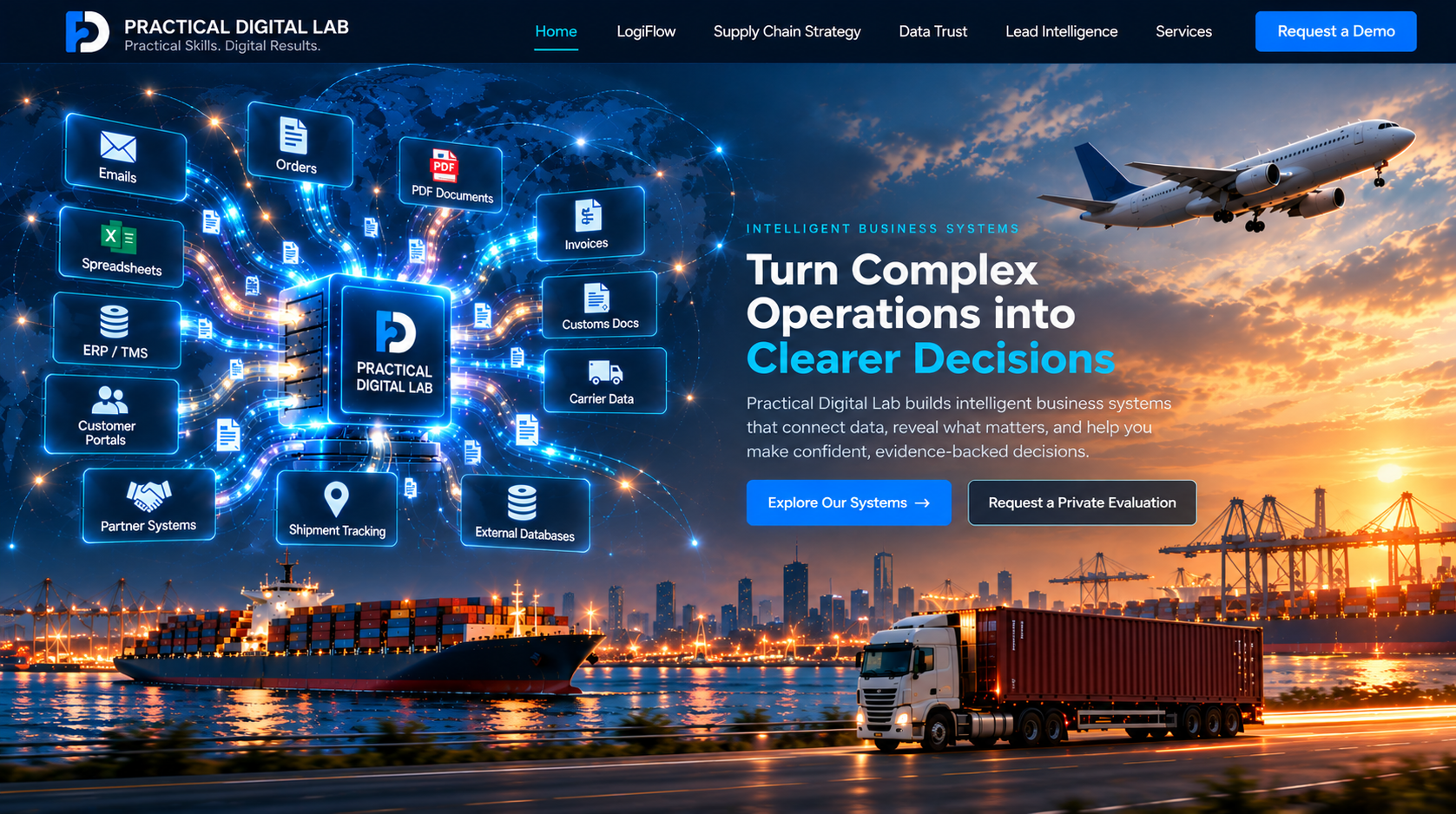
 PRACTICAL DIGITAL LABPractical Skills. Digital Results.PRACTICAL
Four practical demonstrations, each grounded in a decision a business needs to make.

Connect fragmented operational data. Detect what matters. Prioritize action. Keep orders, shipments, documentation and cash moving.
LogiFlow connects orders, shipments, emails, documents and financial records into one operational picture. It identifies what is holding work up, explains the business impact and directs teams toward the next evidence-backed action — before small problems become expensive ones.
A missing proof of delivery can stop a completed shipment from becoming collectible revenue. Select a scenario below to see how LogiFlow connects the evidence gap to its operational and financial consequences.
Interactive operational workflow — choose Missing POD, Shipment delay, Customs issue or Billing blocker below to inspect connected operational consequences.
Operational signals are connected, interpreted and surfaced as coordinated action.
Delivery activity exists, but the proof-of-delivery record required for billing is unavailable.
The shipment shows delivery activity, but the required proof-of-delivery document cannot be verified.
Billing readiness remains unresolved; finance and customer operations need a clear status, not another email chain.
Shipment, order, delivery and document references are checked for agreement. Missing or conflicting evidence is made visible.
Recover the POD, confirm it belongs to the shipment, resolve conflicts and release billing only after the required checks pass.
Illustrative scenario — not a live client shipment or claim of realized savings.
Turn fragmented operational data into validated decisions, measurable improvement opportunities, and actionable business cases.
Every supply chain carries hidden costs, underused capacity, inefficient freight routes, inventory risks, and decisions that deserve closer examination.
The challenge isn't always identifying a problem. It's determining which improvements are worth pursuing, what they could deliver financially, and whether the evidence is strong enough to justify action.
Practical Digital Lab has built a working Supply Chain Strategy System to help organizations answer those questions.
Not another dashboard that simply displays information.
A connected, seven-phase decision-support system that takes operational data through independent validation, network modeling, financial evaluation, sourcing decisions, executive reporting, and ongoing operational monitoring.
Evaluate alternative network designs, sourcing strategies and investment scenarios.
Examine costs, service implications, risks, sensitivity and financial returns.
Build evidence-backed recommendations with clear assumptions and supporting rationale.
Work through data intake, independent QA and network modeling inside the real public application. Phases 4–6 are restricted; Phase 7 (day-to-day Operations Control Tower) is excluded from this public build.
Video overview of the Supply Chain Strategy System.
After exploring the public demonstration, choose a private seven-phase evaluation or request a focused supply chain assessment.
Request controlled access to the seven-phase system with its branded guide and case study. Access conditions and duration are agreed individually.
Request private evaluationProvide a limited operational dataset after scope acceptance. Receive an evidence-backed report with assumptions, decision rationale, prioritized actions and management approval choices.
Target: within 48 hours of accepting the request and receiving usable data, subject to workload and complexity. No purchase obligation.
Request free assessmentWe are willing to sign a lightweight mutual NDA before receiving sensitive business data. Do not submit confidential files through this public form. Data scope, secure transfer, retention and deletion terms will be agreed first. Your information will not be published as a case study without permission.
Data Trust Engine turns fragmented operational data into trusted, connected, decision-ready information.
The interactive demonstration below shows a controlled example. The enterprise offering is intended for organizations dealing with disconnected records, inconsistent reporting and decisions that depend on dependable information.
Sales reports don't match finance. Supplier records contradict purchase orders. Teams spend hours chasing the right spreadsheet. Data Trust Engine is designed to give organizations a clearer, more dependable picture of their information — and the confidence to move forward.
Different departments report different answers to the same business question.
People spend valuable hours checking files, resolving disputes and repeating work.
See what information is dependable, where attention is needed and what remains unresolved.
Give teams a shared, credible basis for reporting, planning and operational action.
Explore a public demonstration or discuss a private enterprise evaluation tailored to your business data challenges.
Request an enterprise evaluation →Most businesses already have data. The problem is that information needed for decisions is scattered across spreadsheets, documents, exports and operational systems that were never designed to work together.
Data Trust Engine creates the controlled layer between fragmented source data and the systems that depend on it.
Instead of asking, “Can we import this file?” the enterprise question becomes:
“Can we trust this information enough to act on it — and can we prove why?”
That is the problem Data Trust Engine is being built to solve.
Data Trust Engine by Practical Digital Lab
Fragmented data in. Trusted operational intelligence out.
Review actual Data Trust Engine run outputs across logistics performance, shipment forecasting, e-commerce forecasting and invoice extraction. All displayed figures come from actual runs on constructed test data.
Video walkthrough followed by the Claude-built DTE actual-run evidence demonstration.
This is a demonstration version of Data Trust Engine. It illustrates selected workflows and does not represent the full capabilities of the system.
These are actual DTE run outputs on constructed test data, not customer results or a live connection to a production system. Enterprise capabilities must be evaluated separately.
Turn fragmented company information into evidence-backed prospect priorities, with the reasoning visible before anyone sends an email.
A company expanding its warehouse, hiring sales staff or entering a new market might need your solution. But a signal is not proof of buying intent. Lead Intelligence evaluates each prospect against your ideal customer profile, weighs supporting and negative evidence, flags uncertainty and makes the next action clear.
This public demonstration uses fictional prepopulated data and does not call an AI API or send emails. It shows the evidence-based qualification and human-review workflow without exposing the private research infrastructure.
Register interest in a focused logistics operations pilot to evaluate exceptions, document readiness, shipment visibility and order-to-cash bottlenecks against a defined workflow.
Register pilot interestUse your own operating assumptions. The calculator estimates capacity value rather than making a fixed savings promise.
Illustrative estimate based on values entered. Actual results depend on workflow, implementation, adoption and operating environment.
Enterprise-grade thinking, tailored to real operating needs — without the cost, complexity or rigidity of oversized systems.
We help organisations turn operational challenges into workable systems: diagnose the problem, design the right solution, test it against real workflows and measure the result.
Reduce repetitive work, connect disconnected processes and introduce controlled automation that teams can trust.
Build purpose-fit applications around how your organisation actually works — not how a generic platform expects it to work.
Turn fragmented data into clear evidence, operational visibility and decisions your team can act on.
Identify bottlenecks, examine operating processes and design practical improvements before committing to technology.
Assess digital tools, existing systems and proposed investments against real business requirements and measurable value.
Validate solutions in a controlled real-world pilot, demonstrate outcomes and scale only what proves useful.
Intelligence where it helps.
Use modern models where interpretation creates value.
Deterministic systems where numbers matter.
Calculations and controls remain auditable.
Humans where accountability matters.
Material decisions stay under operator control.
Start with an operational diagnostic, focused prototype or measurable pilot — without replacing everything you already use.